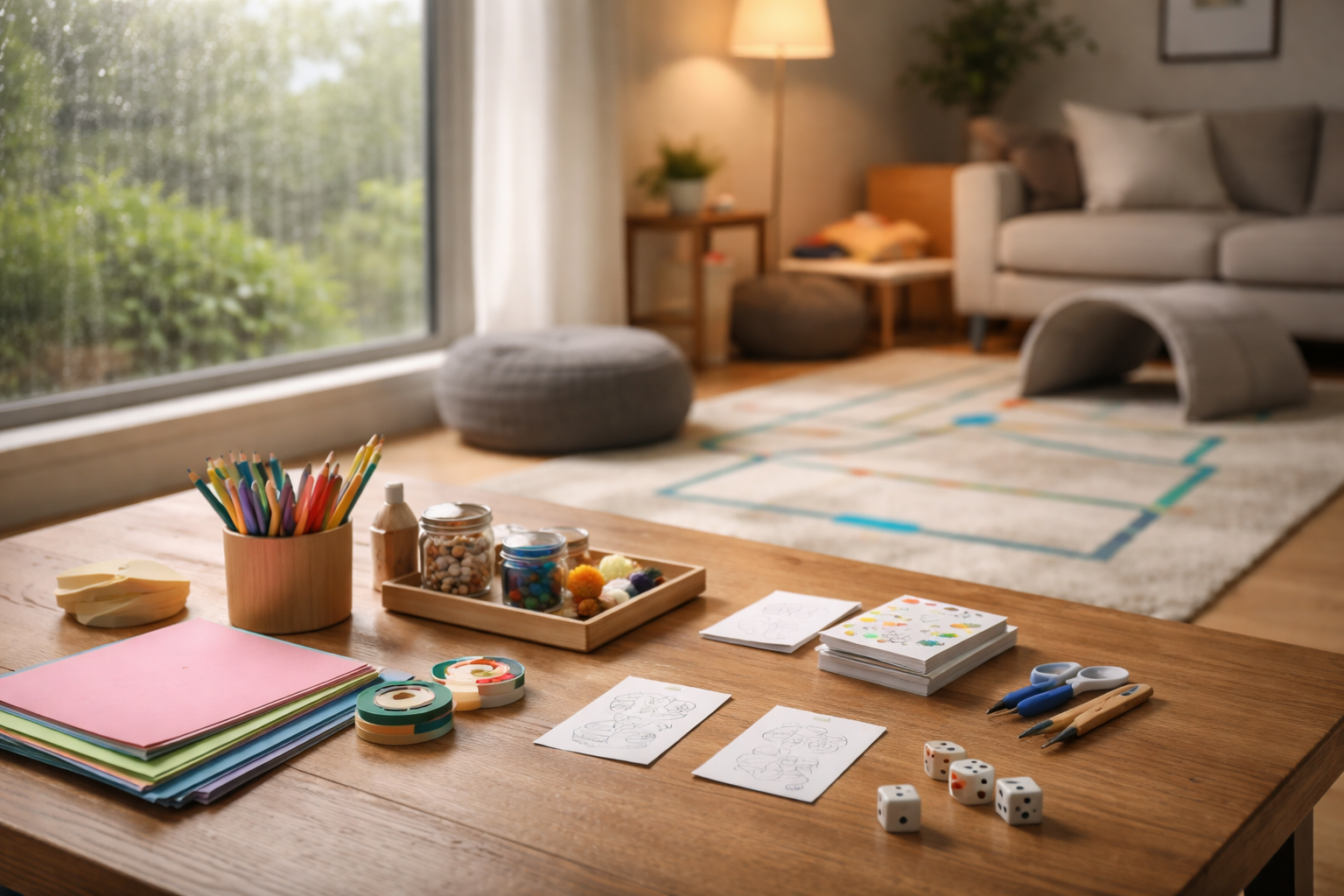
For parents of young children, a stretch of bad weather can turn the house into a pressure cooker. The indoor play challenges pile up fast: kids bounce between screens and whining, siblings clash over space, and adults try to work or reset the day while chaos grows. Without a simple plan, child boredom prevention becomes a nonstop scramble and “bad weather activities” start feeling like one more task. A small, steady approach keeps family engagement indoors calm and consistent.
Quick Summary: Indoor Fun That Still Teaches
- Choose arts and crafts projects that keep kids busy while building creativity and focus.
- Try simple science experiments to turn indoor time into hands-on learning.
- Play indoor games for kids that burn energy and encourage teamwork.
- Rotate educational activities at home to keep boredom low and curiosity high.
Mix-and-Match Activity Menu: 15 Low-Prep Indoor Wins
Bad-weather days don’t have to turn into screen-time marathons. Keep a simple “activity menu” that mixes movement, making, and mini-learning, then rotate based on energy level and the mess you’re willing to manage. If your schedule is packed, a little intentional planning (like the routines in working moms’ busy-season strategies for prioritizing kids) makes it much easier to protect a few minutes of real together time.
- Make an “Indoor Activity Menu” (5 minutes): Write 15 quick options on index cards and sort them into three piles: Move, Make, Think. Pull one card from each pile to build a 30–60 minute block, using the same quick-pick vibe from your earlier TL;DR list. This prevents the “What should we do?” loop and helps kids practice choosing and planning.
- Educational Cooking for Kids: “Snack Lab” with measurements: Pick one no-bake recipe (trail mix, yogurt parfaits, microwave mug cake) and assign roles: measurer, mixer, taste-tester, and cleaner. Kids practice fractions, sequencing, and kitchen safety without a full dinner’s worth of stress. Make it skateboard-themed by sorting ingredients into “deck colors” or creating a “grip-tape crunch” topping using cereal.
- DIY Indoor Obstacle Course: tape, timers, and trick names: Use painter’s tape lines, couch cushions, and a laundry basket “hoop” to build a 6-station course: balance walk, toe-tap slalom, bear crawl, sock-slide stop, target toss, and a final “victory pose.” Rename stations after skate skills (manual line, ollie hop, carve corner) so it feels familiar to board kids. Run it twice: once for fun, once to beat the time, then let them redesign one station like a mini skatepark builder.
- Grip-Tape & Deck Design Studio (low-prep art that teaches): Give kids paper “deck templates” (a traced board shape works) and set rules: 2 colors, 3 shapes, 1 logo. They can create grip-tape patterns, sticker layouts, or a cruiser-board vibe with big blocks of color. Bonus learning: make them label dimensions (length/width) and explain why their design helps “control,” “speed,” or “style.”
- Interactive Board Games with a design twist: Choose a short game and add one “designer rule” kids can propose, test, and revise after a round. That turns game night into hands-on learning about systems, fairness, and iteration, skills that transfer directly to customizing boards and solving problems. The popularity is real: the global board games market valued at USD 21.07 billion reflects how many families lean on games as an indoor go-to.
- Two busy-parent moves: protect 15 minutes + use a “cooperation script”: Schedule one daily 15-minute “together time” block, set a timer, put phones away, and let your child pick one menu card. When you need cooperation fast, borrow the playful reframe in ”Race me to see who can get their shoes on first” and apply it indoors: “We have five minutes, want to race me to clean up the markers?” Small, consistent connection beats big, occasional plans.
Keep a small bin with your basics, tape, cards, dice, washable markers, and a wipe-down cloth, so you can start fast, stay safer, and keep the mess contained when the weather won’t cooperate.
Indoor Rainy-Day Questions, Answered
Q: What are some simple indoor activities that can help keep kids entertained when they can’t go outside?
A: Try a quick rotation: 10 minutes of movement, 15 minutes of making, then 10 minutes of a thinking game. Even five minutes of play can shift attitudes fast, so start small and build. Keep a low-mess swap ready like crayons instead of paint or stickers instead of glitter.
Q: How can I make a rainy day more fun and less stressful for my children at home?
A: Reduce decision fatigue by offering two choices, not ten, and set a timer for each block so it has a clear finish line. Put down an old sheet as a “project mat” and make cleanup part of the game. A simple snack break at the midpoint also resets moods.
Q: What are creative ways to use everyday household items for kids’ arts and crafts projects indoors?
A: Cardboard boxes become mini ramps, “skate shop” displays, or stencil stations for deck-shape outlines. Use painter’s tape for crisp geometric designs, then color in sections with washable markers. Paper grocery bags make great collage backings and are easy to recycle.
Q: How can I create a structured yet enjoyable day for kids stuck inside due to bad weather?
A: Use a light routine: choose, do, show, reset. Post a simple choice board, then add one tiny responsibility like setting out supplies or wiping the table. End each activity with a two-minute reset so clutter never snowballs.
Q: How can customized skateboards offer a fun and unique indoor activity option for kids when outdoor play isn’t possible?
A: Turn design into an indoor studio session: sketch graphics, plan colorways, and create paper deck templates kids can “sponsor” with their own logos. For printables, grab templates online, export to PDF with a secure file tool such as a secure PDF file converter, and save them in a labeled folder for easy reprints. Add an indoor safety check by keeping rolling gear stored and focusing on art, measurements, and layout.
Indoor Rhythm Habits for Rainy-Day Learning
Bad-weather days feel easier when you rely on a few automatic cues instead of reinventing the plan. These habits help skate-minded families keep kids engaged, build skills indoors, and still make room for affordable custom deck design decisions without stress.
Two-Choice Start
- What it is: Offer two indoor options and let kids pick fast.
- How often: Daily
- Why it helps: Fewer choices cut arguments and get learning moving.
Movement Minute Meter
- What it is: Track short bursts toward 60 minutes of moderate to vigorous physical activity.
- How often: Daily
- Why it helps: Quick motion resets energy before quieter projects.
Sketch-to-Deck Sunday
- What it is: Do one weekly deck graphic sketch and price-check parts.
- How often: Weekly
- Why it helps: You spread costs out and keep creativity consistent.
Three-Bin Reset
- What it is: Use Keep, Trash, Put-Away bins after every activity.
- How often: Per activity block
- Why it helps: Cleanup stays small and the next session starts faster.
Routine Card on the Fridge
- What it is: Post a printable daily routine checklist with 3 to 5 blocks.
- How often: Daily
- Why it helps: Predictability boosts cooperation and focus.
Pick one habit this week, then tweak it until it fits your crew.
Turn Stormy Days Into Calm, Creative Indoor Learning Time
Bad weather can trap high-energy kids indoors, and even the most prepared parent can run out of ideas fast. The fix isn’t a perfect plan, it’s a simple indoor rhythm: a few repeatable choices, a clear cue to start, and an easy reset that keeps the day moving. When that mindset becomes routine, play turns into learning, cleanup stops feeling like a fight, and everyone builds confidence together through shared wins. One ready-to-go activity beats five half-started ideas. Pick one idea tonight, gather the basics, and write it on a short “next storm” list. That steady, positive parenting approach builds family bonding through play and the resilience kids carry into every season.
Need a few more ideas? Try these fun, low-prep activities designed to get your kids thinking, creating, and fully engaged.
- Music Maker
 Objective: Introduction to music and rhythm. Materials Needed: Instructions:
 - Art Studio
 Objective: Foster creativity through art. Materials Needed: Instructions:
 - Fitness Fun
 Objective: Encourage physical activity. Materials Needed: Instructions:
 - Math Treasure Hunt
 Objective: Practice math skills in a fun way. Materials Needed: Instructions:
 - Nature Explorer
 Objective: Learn about local flora and fauna. Materials Needed: Instructions: